Applied magnetism · Magnet systems
Applied magnetism & permanent-magnet undulators
Undulators and magnet systems are only as good as their field. As head of the Applied Magnetic Systems Laboratory, I design permanent-magnet (NdFeB) helical undulators and related magnet assemblies, computing the field with magnetostatic simulation and validating against measurement.
Calculating fields and forces in magnet assemblies
For a candidate magnet geometry, such as helices, ring sectors or Halbach arrays (including Halbach undulators), the model computes the three-dimensional field, the on-axis amplitude and its spatial harmonics, and the forces and torques on the assembly. Parametric sweeps then quantify how field amplitude and quality respond to geometry and to realistic magnet tolerances, which is essential for a manufacturable design.
Magnetic field mapping
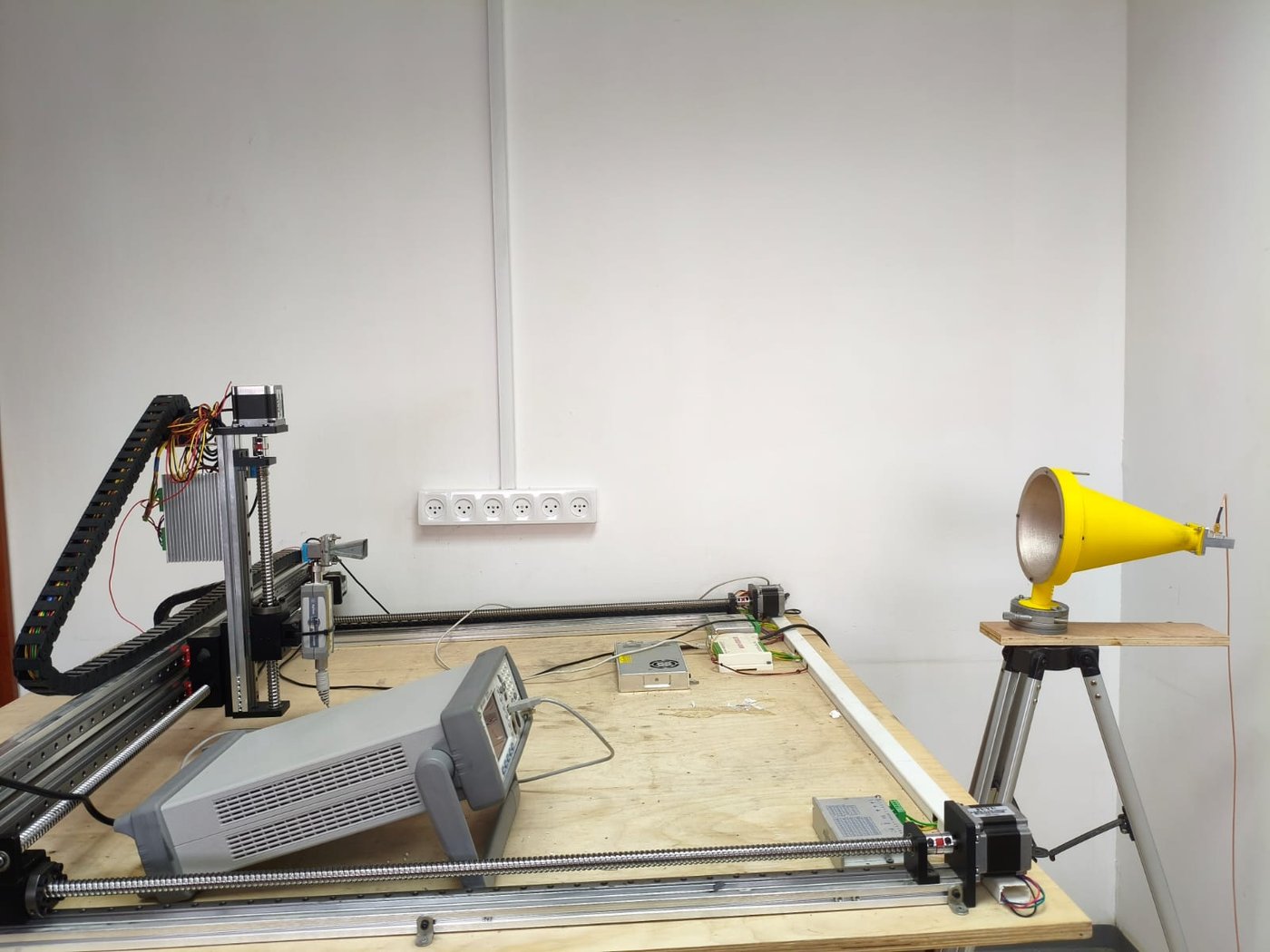
In the lab I map the field of magnet assemblies with a gaussmeter mounted on an XYZ mapping system, which moves the probe along three axes around the assembly. The measured maps are compared with the magnetostatic simulation of the same geometry.
From model to hardware
This work supports compact permanent-magnet undulators for free-electron radiation sources and inverse-FEL acceleration (see compact accelerators), including an international industrial collaboration on undulator fabrication. The same magnetostatic workflow applies to sensors, actuators and magnet systems generally.
Selected magnetics & undulator publications
- Balal N, Bandurkin IV, Bratman VL, Fedotov AE. Helical undulator based on partial redistribution of uniform magnetic field. Physical Review Accelerators and Beams 20, 122401 (2017). doi:10.1103/PhysRevAccelBeams.20.122401
- Magory E, Bratman VL, Balal N. Permanent helical micro-undulators for x-ray free electron lasers. Physics of Plasmas 31, 053301 (2024). doi:10.1063/5.0199053
- Balal N, Bamberg E, Bratman VL, Magory E. Fabrication and Experimental Study of Prototype NdFeB Helical Undulators. IEEE Transactions on Electron Devices 70, 5911–5915 (2023). doi:10.1109/TED.2023.3315250
- Magory E, Bratman VL, Steiner A, Balal N. Implementation of Prototype Permanent Microundulators. Nuclear Instruments and Methods in Physics Research A 1088, 171473 (2026). doi:10.1016/j.nima.2026.171473 · arXiv:2509.06186
- Tokman MD, Bratman VL, Magori E, Balal N. Helical Field-Driven Translational-Rotational Conversion in Conductors. Physical Review E 113, 034213 (2026). doi:10.1103/tnpy-3t47 · arXiv:2509.10042
- Balal N, Bratman VL, Lurie Yu, Magory E. Efficiency of terahertz undulator radiation from short electron bunches moving in the field of permanently magnetized helices. Physics of Plasmas 28, 093301 (2021). doi:10.1063/5.0060778
- Balal N, Bandurkin IV, Bratman VL, Magory E, Savilov AV. Negative-mass mitigation of Coulomb repulsion for terahertz undulator radiation of electron bunches. Applied Physics Letters 107, 163505 (2015). doi:10.1063/1.4934495
Applied research and technical capabilities
- Three-dimensional magnetostatic modelling
- Permanent-magnet and Halbach-array design
- Field harmonics, forces, and torque evaluation
- Tolerance and manufacturability studies
- Simulation-to-measurement comparison
Technical questions and research collaboration: nezahb@ariel.ac.il